
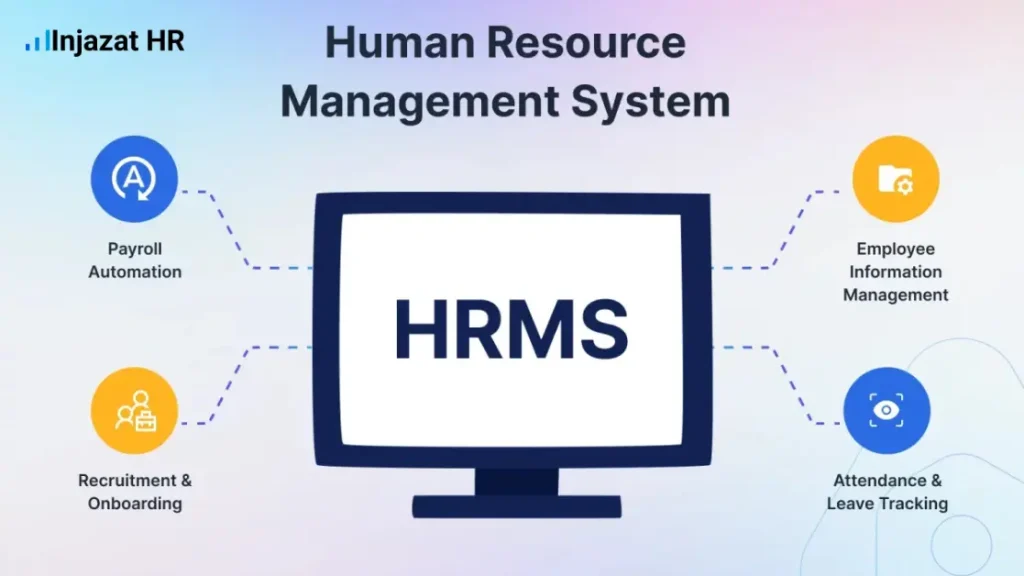
The HRMS — short for Human Resource Management System — is an integrated software platform that brings together all basic and advanced HR functions within a single connected environment. The core purpose of an HRMS is to digitize and automate what used to be done manually: from storing employee data, managing time & attendance and payroll, to supporting higher-impact strategic tasks such as recruitment, performance evaluation, talent management, and training & development plans.
From an operational perspective, an HRMS addresses the challenge of scattered data across disparate tools, paper files, and conflicting spreadsheets by converting them into a unified, instantly analyzable database. From an organizational perspective, it enables leaders to monitor legal compliance and reduce errors, while offering a smooth and transparent experience for both managers and employees. Thus HRMS becomes the backbone of digital transformation in HR management, where information is managed consistently and scalably, and processes are executed faster and more reliably.
The relationship between HRMS and HCM
The term HRMS is often used interchangeably with HCM (Human Capital Management), but there are subtle differences. HRMS focuses on the core administrative structure such as payroll, attendance, and records, whereas HCM expands to include the strategic dimension of managing human capital: talent, development, and organizational culture. HRMS can be seen as the digital foundation upon which broader HCM practices are built, with HRMS modules feeding the analytics and decision-making needed for long-term talent management.
Main components of an HRMS
An HRMS is divided into modules that serve specific functions, working as stacked units within one system, enabling the organization to manage the entire employee lifecycle from hiring to termination. Below is a detailed look at each module and its practical impact.
1) Employee Data Management (Core HR / Employee Data Management)
Employee data management forms the core on which the other modules rest. Through centralized unified files, contract information, job details, historical records, and legal documents can be stored in one organized and accessible location. This focus simplifies data access, reduces duplicate entry, and maintains a single “source of truth” for HR, which reflects in the accuracy of analytics and the ease of data-driven decision-making.
Centralized personnel files including job, contact details, and documents.
Sequential historical records that provide a complete picture of the employee’s journey.
Storage of legal documents and facilitation of readiness for internal and external audits.
2) Payroll & Benefits Management
Payroll and benefits management rely on automation to reduce errors and speed up processing. It automatically calculates wages, bonuses, and deductions, and ties them to the applicable legal framework to ensure compliance. With an integrated mechanism to manage health insurance and benefits, compensation transparency improves, queries decrease, and employees’ trust in the accuracy of their entitlements grows.
Automated calculation of payroll, benefits, bonuses, and deductions.
Data linkage with taxes and regulations to ensure compliance.
Accurate audit reports to support transparency and institutional trust.
3) Time & Attendance Management
Accurate tracking of working hours, attendance, and leaves is a cornerstone of disciplined operations. By integrating HRMS with biometric devices or smart apps, events are recorded automatically, and the manual errors associated with traditional schedules are reduced. As a result, managers receive regular reports that help them distribute work, reduce bottlenecks, and support resource scheduling decisions.
Tracking attendance, check-in/check-out, and leaves accurately.
Integration with biometric devices or mobile apps for real-time recording.
Reports that help effective team planning and cost management.
4) Recruitment & Onboarding
HRMS combines the management of job applications, job postings, and automated CV screening and preliminary interviews, accelerating the access to the best candidates. After hiring, structured onboarding programs ensure a smooth transition that shortens the learning curve and improves new-joiner experience; first-day employees become productive contributors faster.
Managing open positions and applications from a single interface.
Automated CV screening and scheduling of preliminary interviews.
Onboarding programs that ease familiarization with policies, tools, and teams.
5) Performance Management
HRMS supports setting individual and team objectives and monitoring them periodically, enabling performance evaluations, 360-degree reviews, and continuous feedback. With this closed loop, daily efforts align with organizational goals, enhancing productivity and transforming evaluation from a yearly event into a continuous, fair, and transparent process.
Formulation of SMART goals measurable at individual and team levels.
Periodic performance reviews with mechanisms for continuous feedback.
Alignment of performance with incentives and development pathways.
6) Learning & Development
E-learning platforms and tailored learning plans allow for the systematic development of required skills and competencies. By linking learning to performance outcomes, development becomes a targeted investment to close real skill gaps. In this way, professional growth continues and aligns with business objectives and performance strength.
Online training programs that support progressive learning.
Learning plans aimed at strengthening critical competencies.
Tracking training progress and linking it to actual performance results.
7) Compensation & Succession Planning
This module establishes fair and competitive compensation policies that motivate performance and support sustainability. Simultaneously, succession planning ensures readiness of alternate leaders and business continuity during changes. Linking incentives to performance creates a results-driven culture where rewards are outcome-based.
Fair and coherent compensation policies that enhance company competitiveness.
Leadership succession planning to ensure continuity of operations.
Managing performance-linked incentives to drive achievement.
Practical benefits of HRMS

Adopting an HRMS is not just a technical update but a redesign of how work is done. The benefits extend beyond time savings to establishing a more reliable, transparent, and compliant environment. Below is an analysis of the main benefits and how they reflect on organizational performance:
Increased operational efficiency
By automating manual tasks such as attendance and payroll, operational burden decreases and repetitive processes accelerate. The natural outcome is freeing HR teams’ time to focus on qualitative tasks: designing development programs, improving employee experience, and activating talent initiatives.
Speeding routine transactions through digital workflows.
Redistributing time toward higher-value strategic tasks.
Reducing human errors
Relying on a trustworthy central system reduces traditional errors from manual entry or separate spreadsheets. This effectiveness shows in payroll accuracy, attendance records, and analytical reports; it limits disputes and strengthens internal trust.
Eliminating duplication and shortening data transfer between platforms.
Higher data quality control and improved audit outcomes.
Improving legal compliance
HRMS enables organizations to monitor labor laws and taxes and keep records updated continuously. Embedding compliance into the system simplifies audits, reduces the risk of fines, and ensures meeting relevant deadlines.
Automatic alignment with labor and tax requirements.
Accurate, up-to-date records ready for any audit.
Providing comprehensive visibility and transparency
Real-time data and precise analytics provide a full picture of HR: from performance and attendance to benefits and compliance indicators. The resulting transparency reduces guesswork and turns decision-making into an objective, data-driven process.
Dashboards displaying real-time key indicators.
Enabling managers and employees to track goals and entitlements easily.
Supporting strategic decision-making
HRMS reports provide a solid foundation for hiring, development, and restructuring decisions. With accurate data, workforce planning and forecasting become deliberate processes with fewer surprises and greater organizational readiness.
Analytical reports that guide HR decisions.
Workforce planning that anticipates changes based on solid data.
Improving the employee experience
Through self-service portals, employees access their data, leave requests, and payrolls directly, accelerating administrative cycles and reducing friction. This transparency increases satisfaction and belonging, creating a more mature relationship between the employee and the organization.
Self-service channels for requests and inquiries.
Smooth experience that reduces response times and improves communication.
Enhancing talent development
Linking training with performance evaluations makes it easier to identify skill gaps and direct developmental investments where they yield results. The outcome is an environment that celebrates professional progress, prepares future leaders internally, and retains high performers.
Targeted learning that closes real skill gaps.
Internal growth and leadership pathways that ensure continuity.
The history of Human Resource Management Systems (HRMS): from initial digitization to artificial intelligence
1) The beginnings in the 1970s
Digitization began in large companies through automation focused on repetitive, data-heavy processes like payroll and accounting. Systems at this stage were primitive and limited in scope, but they paved the way for turning data into manageable assets and reducing severe errors associated with scale.
2) Evolution in the 1990s
With the rise of centralized computing and the Internet, digitization expanded to cover a broader range of HR functions. Capabilities emerged for managing records, benefits, and recruitment within more integrated platforms, allowing for greater data consistency and easier collaboration between HR teams and operational departments.
3) The modern era
Cloud connectivity and smart technologies led to a qualitative leap; HRMS became able to integrate data from multiple sources, adjust reporting settings in real time, and adapt to regional variations in laws and structures. With the advent of AI and workflow automation, systems became smarter and smoother, making them partners in decision-making rather than mere operational tools.
The difference between HRIS, HRMS, and HCM: a matrix of definitions and scopes
To help choose the most appropriate option, it is useful to distinguish between the three terms in terms of definition and primary use. The table below summarizes the relationship:
| Term | Definition | Primary Use |
|---|---|---|
| HRIS | Human Resources Information System | Managing core data, payroll, time & attendance |
| HRMS | Human Resource Management System | Includes HRIS and adds advanced functions such as talent management and training |
| HCM | Human Capital Management | A comprehensive approach to workforce management from hiring to retirement, encompassing HRMS and HRIS |
It becomes clear that HRIS focuses on basic operational data, while HRMS adds a layer of advanced functions that address the employee lifecycle more broadly, and HCM represents a strategic, comprehensive approach that includes both HRIS and HRMS within a larger framework of human capital management.
The importance of HRMS today: rapid response and data-driven decision-making
HR teams in recent years have become “first responders” to changes in the workforce, making HRMS an organizational necessity rather than an option. The main reasons are summarized below:
Accelerating digital transformation
HRMS has become a driver of digital transformation by automating complex procedures, unifying data sources, and providing self-service portals that keep the organization flexible in the face of change and reduce response times.
Improving talent management
With recruitment, development, and retention tools linked in one system, attracting, developing, and retaining top talent becomes an integrated, data-supported process.
Automating complex processes
HRMS integrates payroll, attendance, reporting, and advanced analytics into smart workflows, shortening manual steps and ensuring smooth execution with scalability.
Supporting strategic decisions
Analytics based on data allow leaders to make impactful decisions about hiring, restructuring, and development, relying on accurate information rather than impressions.
Why Injazat HR is one of the best HR management solutions in Saudi Arabia?
The Injazat HR solution meets local requirements and addresses compliance and efficiency needs in the Saudi environment, through interconnected features that produce tangible operational results:
1) Reducing paperwork and increasing efficiency
The system relies on fully automated workflows that reduce reliance on papers and traditional spreadsheets, freeing valuable time for HR teams to focus on higher-value strategic work. The result of this improvement is up to a 50% reduction in HR administration time.
2) Full compliance with Saudi labor regulations
Injazat HR is designed to comply with local labor laws, including calculating end-of-service entitlements and issuing payroll reports in accordance with the Wage Protection System (WPS). This compliance reduces concerns about deadlines and government requirements and spares the organization from risks and fines.
3) Automated payroll processing
Payroll processing becomes up to 80% faster with instant notifications and accurate checks that reduce manual errors and simplify previously complex processes. The result is smooth and transparent payroll cycles that support internal trust.
4) Accurate time & attendance management
Injazat HR provides real-time mobile check-in/out with geolocation verification, eliminating attendance disputes and ensuring data accuracy, giving managers a reliable basis for planning and scheduling.
5) Simplifying approvals and requests
Leave, loan, and letter requests are managed via a centralized dashboard, with approvals obtained with a single click. This speeds up approval cycles and improves the experience for employees and managers by reducing waiting and overlap.
6) Smart alerts to avoid fines
Automatic notifications are issued before document expirations, maintaining continuous compliance and reducing legal risks caused by missed updates or unintended delays.
7) Seamless integration with government entities
Injazat HR provides two-way integration with Muqeem to update residency, ID, and passport data automatically without manual entry. This achieves continuous record freshness and enhances accuracy and audit readiness.
8) Full functional coverage of the employee lifecycle
The system covers all stages of the employee lifecycle from recruitment to termination through connected processes that reduce administrative pressure, raise employee satisfaction, and ensure continuity without interruptions.
Summary of quantitative performance impacts in Injazat HR
| Area | Impact |
|---|---|
| HR management time | Reduced by up to 50% |
| Payroll processing speed | Increased by up to 80% |
These indicators show how Injazat HR combines local compliance and operational improvement, making it a practical choice for organizations operating in the Kingdom that seek measurable results.
FAQ About HRMS
What is a Human Resource Management System (HRMS)?
HRMS is an integrated digital platform through which basic and advanced HR functions are managed in one place, from storing employee data, attendance, and payroll, to recruitment, performance management, learning & development, compensation, and succession planning. The goal is automation and digitization to raise efficiency, reduce errors, improve compliance, and enhance the employee experience.
What is the difference between HRMS and HCM?
HRMS focuses on administrative functions such as payroll, attendance, and records, while HCM includes the strategic dimension of human capital management such as talent, development, and organizational culture. HRMS can be considered the operational foundation operating within the broader HCM approach.
What is the difference between HRIS, HRMS, and HCM?
HRIS handles basic data management, payroll, and time & attendance. HRMS includes HRIS and adds advanced functions such as talent management and training. HCM is a comprehensive approach to workforce management from hiring to retirement and encompasses both HRIS and HRMS within its framework.
What are the main components of any modern HRMS?
Core components include: employee data management, payroll & benefits, time & attendance, recruitment & onboarding, performance management, learning & development, and compensation & succession planning. These modules work together to manage the full employee lifecycle.
What practical benefits does HRMS bring to companies?
Key benefits: increased operational efficiency through automation, reduced human errors thanks to a central system, improved legal compliance, comprehensive visibility and transparency, support for strategic decisions with accurate data, improved employee experience through self-service, and enhanced talent development by linking training to performance.
How have HRMS systems evolved over time?
They began in the 1970s with limited automation of payroll and accounting. In the 1990s they expanded with centralized computing and the Internet to include records, benefits, and recruitment. In the modern era, with cloud technologies, AI, and workflow automation, HRMS systems became more integrated, intelligent, and adaptable to regional differences.
Why is HRMS important now?
Because HR teams have become “first responders” to workforce changes, HRMS ensures accelerated digital transformation, improved talent management, automation of complex processes, and analytics that support institutional decisions.
How does HRMS support compliance with laws and regulations?
It provides automatic monitoring of labor laws and taxes and generates accurate records ready for audits. In Saudi Arabia, for example, it facilitates issuing payroll reports in line with WPS and calculating end-of-service entitlements according to regulations.
Why is Injazat HR suitable for companies in Saudi Arabia?
Because it combines comprehensive automation that reduces paperwork and increases efficiency, full compliance with local regulations including WPS and end-of-service calculations, two-way integration with Muqeem for automatic updates of residency and ID data, faster payroll processing, accurate attendance management, simplified approvals, and smart document alerts.
How does HRMS contribute to reducing human errors?
Through data centralization and automation, reliance on manual entry and scattered spreadsheets decreases, improving the accuracy of payroll, attendance, and reports. This reduces disputes and increases the reliability of information used in HR management.
Executive summary
HRMS unifies data and processes across integrated modules ranging from operational basics to strategic functions, giving the organization efficiency, speed, compliance, and visibility that help make decisions grounded in reality. Locally tailored solutions, such as Injazat HR in Saudi Arabia, stand out for their regulatory alignment, deep automation, vital integrations, and measurable results in time reduction and payroll acceleration. With these foundations, HRMS becomes not just an information system but a platform to elevate human capital management maturity and turn it into a sustainable competitive advantage.